A crypto wallet doesn’t store assets like a physical wallet. Your bitcoin or ether stays on the blockchain. The wallet manages private keys that prove you can access and move those assets. Lose the key, and access is gone permanently. Control depends on the setup: exchanges hold keys in custodial accounts, while self-custody wallets give you full ownership. This choice affects security, responsibility, and risk, making it important to understand how wallets work before deciding.
What a Crypto Wallet Actually Does
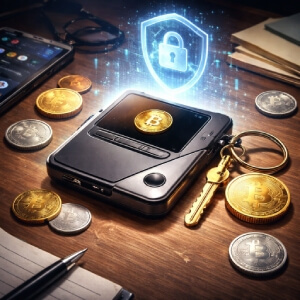
A crypto wallet is less like a purse and more like a keychain. It does not hold the bitcoins or stablecoins the way a bank account holds dollars. These assets merely exist as entries on the public blockchain. Only cryptographic keys remain with the wallet to claim ownership.
Each time a wallet is created, a pair of companion data is created as well. The private key actually includes two keys; the private key from which we derive our public key, which is nothing but your public address, equivalent to an account number on which anyone could send funds. On the contrary, only your private key is the authorization to transfer funds.
If you lose your private key, your fortune of decentralized assets on the blockchain is gone forever. Often, a wallet will generate a seed phrase that can be either 12 or 24 random words which can be used to recreate the private keys from scratch. Write that down safely somewhere.
When you send a friend a transaction, your wallet does not send coins. Instead, it signs a message attesting to the transaction with the private key which it knows. Hence, only you can make the blockchain record the adjustment in balances. With self-custody, it means that you are in control of those keys, not any exchange.
Custodial vs Non-Custodial Wallets: Who Controls the Keys
Think of it as the difference between a bank vault and a safe in your own home. Exchanges like Coinbase or Binance offer custodial wallets, meaning they hold your private keys on your behalf. You log in with an email and password, and the platform manages the cryptographic credentials behind the scenes.
That convenience has real appeal. Forgotten your password? Customer support can help. Custodial services also tend to have cleaner interfaces, making them easier for beginners. The tradeoff is counterparty risk. If the platform is hacked, freezes withdrawals, or collapses - as FTX did in 2022 - your funds can be locked or lost entirely.
Non-custodial wallets hand control back to the user. Apps like MetaMask or hardware devices like Ledger store your private keys locally, so no third party can access or freeze your assets. The catch is that responsibility shifts entirely to you. Lose your seed phrase and there is no recovery option.
Custodial wallets suit people who prioritize ease of use and accept platform risk. Non-custodial wallets suit those willing to manage their own security carefully.
Hot Wallets, Cold Wallets, and Real Security Tradeoffs
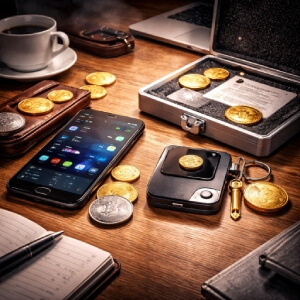
Think of the difference as roughly equivalent to carrying cash in your pocket versus locking it in a safe at home. Hot wallets - mobile apps like MetaMask or Trust Wallet, browser extensions, and desktop clients - stay connected to the internet. That connectivity is convenient, but it also means they're exposed to phishing attacks, malware, and device theft around the clock.
Cold wallets take a different approach. Hardware devices like the Ledger Nano X or Trezor Model T store your private keys entirely offline, meaning a hacker with access to your internet connection still can't reach them. That reduced attack surface is genuinely valuable for anyone holding significant amounts.
Neither type is without risk, though. Hot wallets are vulnerable to compromised devices. Cold wallets can be lost, damaged, or rendered useless if you mishandle the backup seed phrase during setup - a surprisingly common mistake among new users.
A reasonable approach many people use: keep a small amount in a hot wallet for regular transactions, and move larger holdings into cold storage. It's the digital equivalent of not walking around with your entire savings in your back pocket.
Self-Custody Gives Control But Demands Discipline
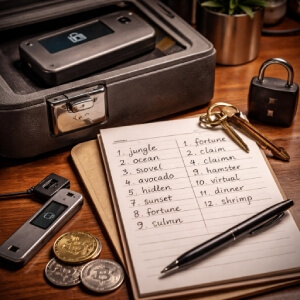
Taking full ownership of your crypto means accepting full responsibility for it. There is no customer support line, no fraud team, and no account recovery process if something goes wrong. That reality shapes everything about how self-custody should be approached.
The seed phrase is the single most important thing to protect. This is a sequence of 12 or 24 randomly generated words that can restore your entire wallet on any compatible device. Write it down on paper, store it somewhere physically secure like a fireproof safe, and never photograph it or save it in a cloud service. Anyone who has those words has your funds.
Phishing attacks are probably the biggest practical threat most users face. Scammers build fake wallet websites, send convincing emails, and sometimes impersonate support staff in Discord servers. No legitimate wallet service will ever ask for your seed phrase.
Address verification matters too. Always confirm the first and last several characters of any wallet address before sending funds.
Inheritance planning is easy to overlook. If only you know your seed phrase and you become incapacitated, those assets may be permanently lost. A sealed, written record stored with a trusted person or attorney is a reasonable precaution. Self-custody is genuinely empowering, but only when paired with habits that match the responsibility it carries.
Control Only Matters If You Can Protect It
One thing is for sure, owning cryptocurrencies is not equal to controlling them. Custodial wallets in cryptocurrency allow exchanges to hold onto keys, whereas non-custodial wallets provide full control while putting the burden of recovery against loss of the wallet on the owner. Hot wallets would be useful for any actions of exchange, while cold wallets are perfect for storage. What you think is most important to you would mostly hinge on timeless analysis of security, convenience, and personal commitment.
Read More
$KAS solved the blockchain trilemma
— Sukie (@bySukie) July 27, 2025
Proof of Work, Nakamoto consensus, decentralized, secure & scalable.
Im bullish on Kaspa. 💚 pic.twitter.com/5BxsdHTz9w
Bitcoin has reached gold parity. 1 Kg of Gold Now Costs Same as 1 BTC. 🚀#Bitcoin #crypto #blockchain #cilionaire #cryptocurrency #crypto #cryptocurrencies #cryptotrading #cryptonews #cryptoming pic.twitter.com/mfHDne2j9z
— Mohini Of Investing (@MohiniWealth) July 28, 2025
With the kind help from
